










Heewon Chang Interview
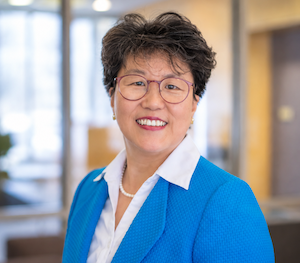 Former Program Chair, PhD in Organizational Leadership
Reflecting on her years of dedicated service, Dr. Chang discusses the evolution of the PhD in Organizational Leadership program at Eastern University. In this exclusive interview, she explores the deep connection between relational theology and collaborative scholarship, the necessity of intellectual humility, and the remarkable resilience of the Eastern community during times of institutional challenge.
Interview with Heewon Chang
Dr. Chang: Leadership and followership are really two sides of the same coin, especially when we recognize that, aside from God, there is no ultimate leader. Good followership actually requires questioning and challenging authorities to help leaders incorporate necessary insights. If we recognize the innate leadership potential in everyone, it prevents us from losing sight of collaborative community-building.
As for stepping up, I don't view myself as a reluctant leader. After honest discernment, I tend to embrace challenges as a calling. It's a subconscious inclination to lean into problems to solve them—much like my mother, who even in her 90s, once stepped up to help a bleeding man on the street when no one else would.
Dr. Chang: I view faith as a foundational undercurrent rather than a separate administrative tool. I liken it to an ocean supporting a ship. It is always there, holding the work up, but it becomes much more consciously apparent when we encounter difficult organizational situations or interpersonal challenges with colleagues and students.
When making decisions, I tend not to rethink or recant commitments once they are made after prayer. We move forward despite our human flaws and incompleteness, finding peace in the acknowledgment that God walks with us.
Dr. Chang: My faith is deeply rooted in relational theology—how we relate to God, to others, and to the community. In scholarship, claiming absolute truth without acknowledging human limitation is simply arrogant. Both qualitative and quantitative researchers must acknowledge the inherent limitations of their scientific findings. This positional humility is deeply Christian.
This is also why I value the transition toward collaborative scholarship. Growing up in Korea, community-oriented phrasing like "our school" or "our mother" was standard. While doctoral work often emphasizes solo effort, true reflection and deeper discourse happen in community.
Dr. Chang: I look for individuals who demonstrate a wise, reflective, and inclusive faith, rather than a focus on narrow evangelism. Leaders operating in diverse secular or non-Christian environments must be "wise as serpents and gentle as doves." It is about living out your faith authentically and relationally, without relying purely on narrow evangelization tactics.
Dr. Chang: First, it has been immensely fulfilling to witness the noble purposes of our students and to work alongside such dedicated colleagues. But what truly stands out is our institutional resilience and remarkable community spirit.
Like many institutions, we have faced historical financial struggles and navigated incredibly difficult times in higher education. Yet, during those periods of instability, our community grew stronger. There was a profound willingness among the faculty to make personal and financial sacrifices to ensure the institution stayed afloat. That mutual dedication to our shared mission is something I will always cherish.