











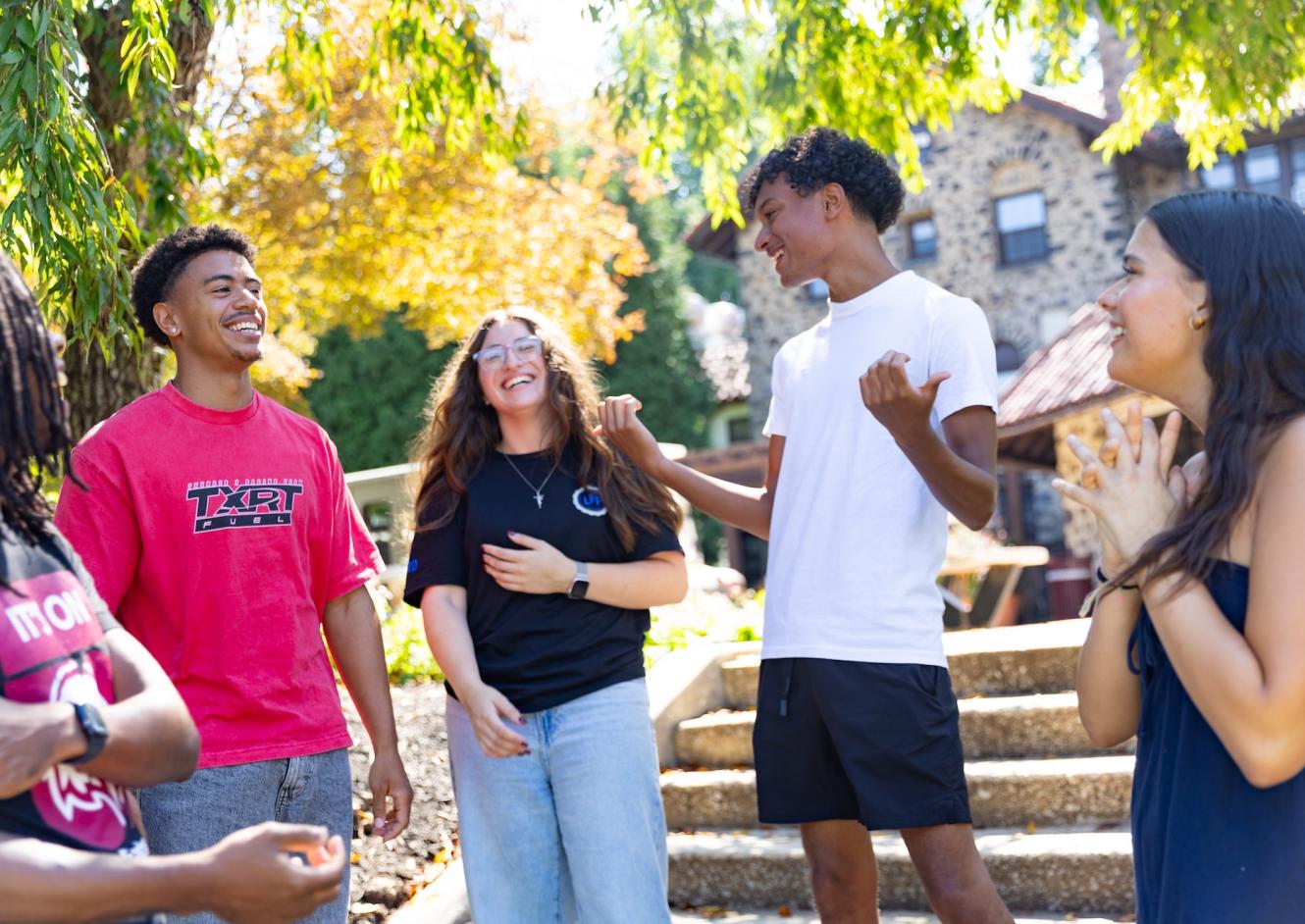
Navigating college isn’t always a straightforward path.
Every student encounters different challenges and experiences along the way. Some begin as traditional undergraduate students, while others transfer, study online, or arrive as visiting students. Many change majors, explore new academic interests, or need additional support as they navigate their next steps.
Sarah Todd ’13, M.Ed., Director of First-Year Experience and Programs, and Nicole Markert ’20, MFA, Director of Academic Advising, saw an opportunity to create a more intentional way to help students navigate those different paths. With the support of Provost Dr. Kent Sparks and Assistant Provost Rebecca Gidjunis, M.F.A., they established Eastern’s Center for Academic Planning and Empowerment (CAPE) in August 2026.
Located on the third floor of Centennial Hall, CAPE brings academic planning and student support together in one place. The center offers a low-stimulation environment where students can stop in, ask a question, grab a snack, or simply take a breath.
“I think about CAPE as a GPS. Maybe you had a plan of taking the highway, but it turns out that there's an accident and it's blocked. We can be the GPS to help you find another way around the barrier that you've encountered and give you the knowledge or the tools you need to get around the challenge you’re facing.”
The center comes at a time when Eastern’s student population is changing rapidly. The University’s student body has nearly tripled since 2019, and 40% of traditional undergraduate students are first-generation college students. Eastern has also welcomed an increasing number of students transferring from other colleges, as the higher education landscape continues to change.
CAPE is part of how Eastern continues to adapt its support as its students and their needs grow and change.
“We wanted to find a way to help bridge the gaps of students' experiences and be a hub of warmth and care,” Todd said.
That need became especially clear when several students transferred to Eastern from a neighboring institution that had recently closed.
“For the students who came over at such a stressful time, it was really important to us that they have a central person that they can speak to. They've been through so much, and they really just need one person that they know that they can always go to, who's gonna know their story, and they don’t have to explain themselves.”
That same approach extends beyond transfer students. CAPE works with students who are exploring majors, changing academic programs, participating in dual enrollment, or visiting Eastern as guest students. Todd advises exploratory and first-year students, while Markert works with dual-enrollment, visiting and guest students, as well as students who need more individualized advising.
The center also helps students and advisors navigate some of the less obvious parts of college.
“Within higher ed, there's a lot of what we call ‘a hidden curriculum,’” Todd said.
This 'hidden curriculum' can include knowing when a course can no longer be dropped, understanding academic expectations, or knowing which campus office can answer a particular question.
“A lot of our work is to make sure that students get the information they need, but also that it's delivered to them in a way that’s empowering and encouraging so that they can make good choices,” Todd said.
That work begins with Eastern’s first-year seminar course, Interdisciplinary Studies (INST), which is required for all first-year students. Designed to help students transition to Eastern, the course includes three sections: one for traditional undergraduate students, one for online students, and one for transfer students.
Through INST, students are introduced to the resources available to them at Eastern, as well as opportunities such as campus employment, teaching assistantships, internships, and leadership positions. Students also create resumes and learn about resources that can help them pursue those opportunities.
“The biggest thing we have to do is make sure our students know about opportunities and feel empowered to go after them,” Todd said.
Todd intentionally designed the courses to include leadership opportunities that encourage students to take responsibility and develop skills that will benefit them in the workforce.
“If you don't know that you can become something, you won't try,” Todd said.
For Todd, helping students recognize what they are capable of becoming is at the heart of her work. Her passion for supporting students is also reflected in her published work in the academic journal Christian Higher Education, where she explored what motivates first-year students to become leaders as sophomores. For many of the students she interviewed, mentorship played a central role.
“For a lot of them, the choice was, ‘I had a great mentor, and I'm going to be that mentor.’ Or ‘I didn't, and I want to be one’,” Todd said.
CAPE extends that focus on mentorship through peer advising, giving older students the opportunity to support their classmates. Markert established the Student Advising Specialist Program, which trains student workers to help their peers navigate Eastern’s academic and technological systems, including MyEastern and Brightspace, as well as academic planning, service hours and questions from incoming students.
“Students sometimes feel a little bit shy asking for help with things because they don't want to look silly. So having peer advisors really breaks down barriers so that [students] can be more comfortable. Learning from a peer is way less intimidating,” Markert said.
For Todd and Markert, those moments reflect the larger purpose behind CAPE: making sure students do not have to navigate college alone. Whether a student is choosing a major, adjusting to a new institution, looking for a new opportunity, or simply trying to figure out where to turn, CAPE is there to help them find their way forward.