










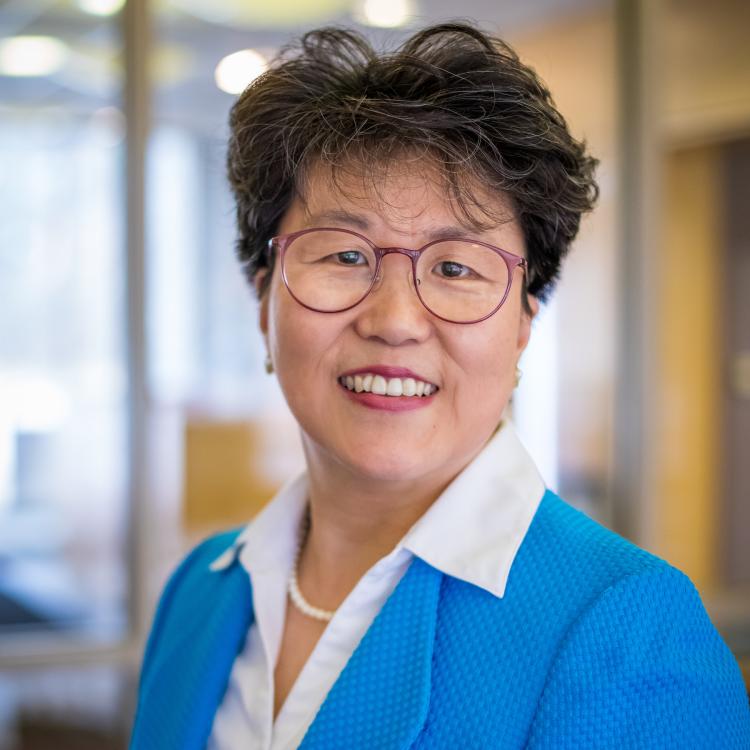
Heewon Chang, PhD, retired from Eastern University after 30 years of service, first as a professor of education and later as a professor of organizational leadership. During the final 10 years of her tenure, she also served as chair of the PhD in Organizational Leadership department. Trained as an educational anthropologist and ethnographer, she taught research methods and multicultural education in the education department and, later, qualitative research methods, organizational leadership, and education courses in the PhD program as part of the College of Business and Leadership.
Chang published seven books and numerous articles and book chapters and presented her work at international conferences. Since the publication of her first book, U.S. Adolescent Life and Ethos: An Ethnography (1992), she has devoted much of her scholarship to advancing autoethnography, an ethnography-rooted research method. Her forthcoming book extends this work by integrating autoethnography with systems thinking for organizational researchers and practitioners. Her collaboration with PhD faculty, alumni, and students also led to the publication of two books, one on leadership and followership and the other on doctoral education (see the book list below).
As a dissertation and thesis advisor, Chang supervised 24 PhD dissertations and 19 master’s theses, while serving on many more as a committee member. In retirement, she continues to think, read, and write about matters of faith, reason, and justice and occasionally advises PhD dissertation students.
Education
- Ph.D. in Education and Anthropology, University of Oregon
- M.A. in Education and Anthropology, University of Oregon
- B.A. in Education, Yonsei University, Seoul, Korea
- Teaching Certifications (Secondary Ethics, Korea; K-6 Elementary, Pennsylvania)
Journal Founding and Editing
- Electronic Magazine of Multicultural Education (Founding Editor-in-Chief, 1997-2006)
- International Journal of Multicultural Education (Founding Editor-in-Chief, 2007-2018)
- Journal of Autoethnography (Editorial Board, 2018-present)
- Journal of Qualitative Inquiry (Editorial Board, 2019-present)
- Journal of Korean Association for Qualitative Research (2015-present)
Research Interests
- Autoethnography and Qualitative Research Methods
- Organization and Leadership
- Systems Thinking
- Higher Education and Doctoral Education
- Cultural Diversity and Societal Justice
Books
- Chang, H., Logan, H. J., & Bryan, L. M. (2026). Walking the Doctoral Trail: A Fully Relatable (and Occasionally Humorous) Guide for Successful Completion and Beyond. Myers Education Press.
- Chang, H., James, J., & Hernandez, K. (2025). Leadership and Followership for 100 Years: Lessons from Practice, Research, & Reflection. College of Business and Leadership, Eastern University.
- Hernandez, K., Chang, H., & Bilgen, W. (2022). Transformative Autoethnography for Practitioners: Change Processes and Practices for Individuals and Groups. Myers Education Press (Received American Educational Studies Association’s 2023 AESA Critic’s Choice Book Award).
- Chang, H., Ngunjiri, F., & Hernandez, K. (2013). Collaborative Autoethnography. Routledge.
- Chang, H., & Boyd, D. (2011, Eds). Spirituality in Higher Education: Autoethnographies. Routledge.
- Chang, H. (2008). Autoethnography as Method. Routledge.
- Chang, H., (1992). Adolescent Life and Ethos: An Ethnography of a US High School. Falmer Press.
Journal Articles and Book Chapters
Selected Bibliography
- Chang, H. (2026). Where the personal meets the sociocultural: Autoethnography for social science research, praxis, and pedagogy (2nd ed.). In A. Porferl & N. Schröer (Eds.), Handbuch sociologische ethnographie [Handbook of sociological ethnography] (pp. 433-446). Springer-Verlag.
- Chang, H. (2025). How to do individual and collaborative autoethnography: Conceptual and methodological learning activities. In AM research skills: Ethnic and indigenous studies (Case Study). Marlborough.
- Chang, H. (2025). Foreword. In F. Gonot-Schoupinsky and C. Mayer (Eds.). Positive autoethnography: Theory and practice. Emerald.
- Chang, H. (2025). Followership that develops good leaders. In. H. Chang, K. C. Hernandez, & J. James, (Eds.) (2025). Leadership and Followership for 100 years: Lessons from Practice, Research, and Reflection (pp. 50-51). Eastern University College of Business and Leadership.
- Chang, H. (2024). Afterword. In E.Trinh, L. J. P. Herrera, & B. Yazan (Ed.), Autoethnographies of border-crossing and in-betweenness of international doctoral students’ voices in the United States (pp. 236-239). Brill.
- Butcher, F. A., Towner, S., Towner, A., Chang, H., & Kassa, A. (2024). BIPOC doctoral students' insights about collaborative learning: A collaborative autoethnography study of an academic program evaluation. International Journal of Doctoral Studies, 19. Article 14.
- Chang, H. (2022). Where the personal meets the sociocultural: Autoethnography for social science research, praxis, and pedagogy. In A. Porferl & N. Schröer (Eds.), Handbuch soziologische ethnographie [Handbook of sociological ethnography]. Springer-Verlag.
- Chang, H. (2021). Individual and collaborative autoethnography for social science research. In Holman, S., Adams, T., & Ellis, C. Handbook of autoethnography (2nd ed.). Routledge.
- Sparks, C., & Chang, H. (2021). Doctoral Capstone Products: A Systems Thinking Model for Quality Assurance. Christian Higher Education, 20(1-2), 38-56.
- Chang, H., & Bilgen, W. (2020). Autoethnography in Leadership Studies: Past, Present, and Future. Journal of Autoethnography, 1(1), 93-98.
- Lee, H., Bryan, L., & Chang, H. (2019). Doctoral students’ learning success in online-based leadership programs: intersection with technological and relational factors. The International Review of Research in Open and Distributed Learning. 21(1), 61-81.
- Hernandez, K. A., Chang, H., & Ngunjiri, F. (2017). Collaborative autoethnography as multivocal, relational, and democratic research: Opportunities, challenges, and aspirations. Auto/Biography Studies, 32(2). 251-254.
- Chang, H. (2016). Autoethnography in health research: Growing pains? Qualitative Health Research, 26(3), 443-45.
- Ngunjiri, F. W., Chang, H., & Hernandez, K. (2016). Multivocal meaning making: Using collaborative autoethnography to advance theory on women and leadership. In J. Storberg-Walker & P. Haber-Curran (Eds.), Theorizing women & leadership: New insights & contributions from multiple perspectives (pp. 87-96). Information Age Publishing.
- Longman, K., Chang, H., & Loyd-Paige, M. (2015). Self-analytical, community-building, and empowering: Collaborative autoethnography of leaders of color in higher education. Journal of Ethnographic and Qualitative Research, 9, 268-285.
- Hernandez, K., Ngunjiri, F., & Chang, H. (2015). Exploiting the margins in higher education: A collaborative autoethnography of three foreign-born female faculty of color. International Journal of Qualitative Studies in Education, 28(5), 533-551.
- Chang, H., Longman, K., & Franco, M. (2014). Leadership development through mentoring in higher education: A collaborative autoethnography of leaders of color. Mentoring & Tutoring: Partnership in Learning, 22(4), 373-389.
- Chang, H. (2013). Individual and collaborative autoethnography as method: A social scientist’s perspective. In Holman, S., Adams, T., & Ellis, C., Handbook of autoethnography (pp. 107-121). Routledge.
- Chang, H. (2011). Autoethnography as method for spirituality research in the academy. In Spirituality In higher education: Autoethnographies (pp. 11-30). Routledge.
- Chang, H. (2007). Autoethnography: Raising cultural awareness of self and others. In G. Walford, (Ed.), Methodological developments in ethnography: Studies in educational ethnography (Volume 12) (pp. 207-221). Elsevier.
Awards
- Critic’s Choice Book Award, American Educational Studies Association (2023)
- McGraw Hill Higher Education Distinguished Scholar Award, AABSS (2017)